
Building an AI Data Center in North Dakota & It Made Me Think About Water

North Dakota
The future Home of Artificial Intelligence
Have you ever wondered why something as futuristic as artificial intelligence might depend on something as basic as water?
Living in North Dakota teaches you strange things about the future. You expect snow. Wind. Silence. Long roads and even longer skies. You don’t expect to hear that one of the world’s most advanced artificial intelligence infrastructures is being built just a few miles away.
But here we are. Massive AI data centers. Right in the middle of the prairie, and it made me pause not because of the technology, but because of something much more basic:
Water.
The part nobody talks about: AI is thirsty

When we discuss AI, we often envision something intangible. Clouds, code, and algorithms floating in digital space, which is funny, because when you start understanding what agentic AI really means for solo business owners, you realize how physical and operational it actually is.
But AI lives in very real, and very physical machines. Those machines get hot. Very hot.
Data centers cool them down, and one of the most efficient ways to cool giant computing systems is… water. Not because AI “drinks” it — but because it got hot. Very hot.
Every question you ask, every image generated, every model trained produces heat. Water absorbs that heat. Sometimes directly. Sometimes, through multi-layered systems, and water cools the air that keeps the servers from overheating.
It’s a cooling system in layers, nested inside each other like Russian dolls, only drenched.
So… how much water does AI use?
It depends on the data center, but the numbers are not small. Large AI facilities can use hundreds of thousands to millions of liters of water per day. Yes, per day!
A single query uses a tiny fraction. Multiply those tiny fractions by billions of users worldwide, and you’re looking at a significant sum that adds up faster than we imagine.
Suddenly, intelligence has a physical footprint, and it made me think:
If water is finite. The planet isn’t getting more of it. So how long can this go on?
will humans run out of water before AI does?

Here’s the honest answer
If AI ever dies because of water scarcity, it’s because humans were already in serious trouble. Agriculture, cities, and energy systems have depended on vast amounts of water long before AI even existed.
The interesting part?
AI itself is already evolving beyond its dependence on water.
New data centers are moving toward:
Closed-loop cooling (reusing the same water again and again).
Cold-climate locations (like North Dakota, Iceland, Norway).
Immersion cooling (servers submerged in special liquids).
Liquid metal and oil-based cooling.
Some systems even harvest server heat and reuse it to warm buildings.
So, AI isn’t here to drink all the water we have. It’s actually evolving toward efficiency, elegance, and adaptability. Basically, it came to North Dakota to enjoy the cold weather and use it effectively.
What in the world! I never thought anyone would benefit from North Dakota’s irreverent cold.
The data center being built in Harwood, North Dakota, is led by Applied Digital, a company specializing in large-scale infrastructure for AI and high-performance computing.
The facility will utilize a closed-loop water cooling system, which means the same water is continuously recirculated within a sealed system to absorb heat from the servers, cool down, and be reused—rather than constantly pulling in fresh water or releasing it as waste.
In practical terms, this dramatically reduces overall water consumption while keeping the massive computing systems efficiently cooled.
But What About the Energy?
Here’s the part most people forget to ask. Cooling is only half the story; the other half is energy — and AI data centers are famously hungry.
The Harwood facility is expected to draw hundreds of megawatts of power. That’s not a typo. It’s the energy load that could power tens of thousands of homes.
Which leads to the next question: where does that electricity come from?
In this case, the regional North Dakota grid supplied by local power cooperatives, and North Dakota produces more electricity than it consumes, with a large share coming from wind energy.
In other words, this data center wasn’t placed here by accident. It was placed where energy is abundant, cheap, and increasingly renewable.
There’s also another advantage no one talks about: North Dakota’s cold climate naturally reduces cooling needs. Less heat to fight means less energy wasted just keeping machines alive.
So the real picture looks like this: AI doesn’t just need water. It needs strategic geography, smart grids, and climates that work with physics instead of against it.
The future of intelligence isn’t floating in the cloud. It’s very much grounded in wind, wires, cold air, and real places on the map.
The paradox
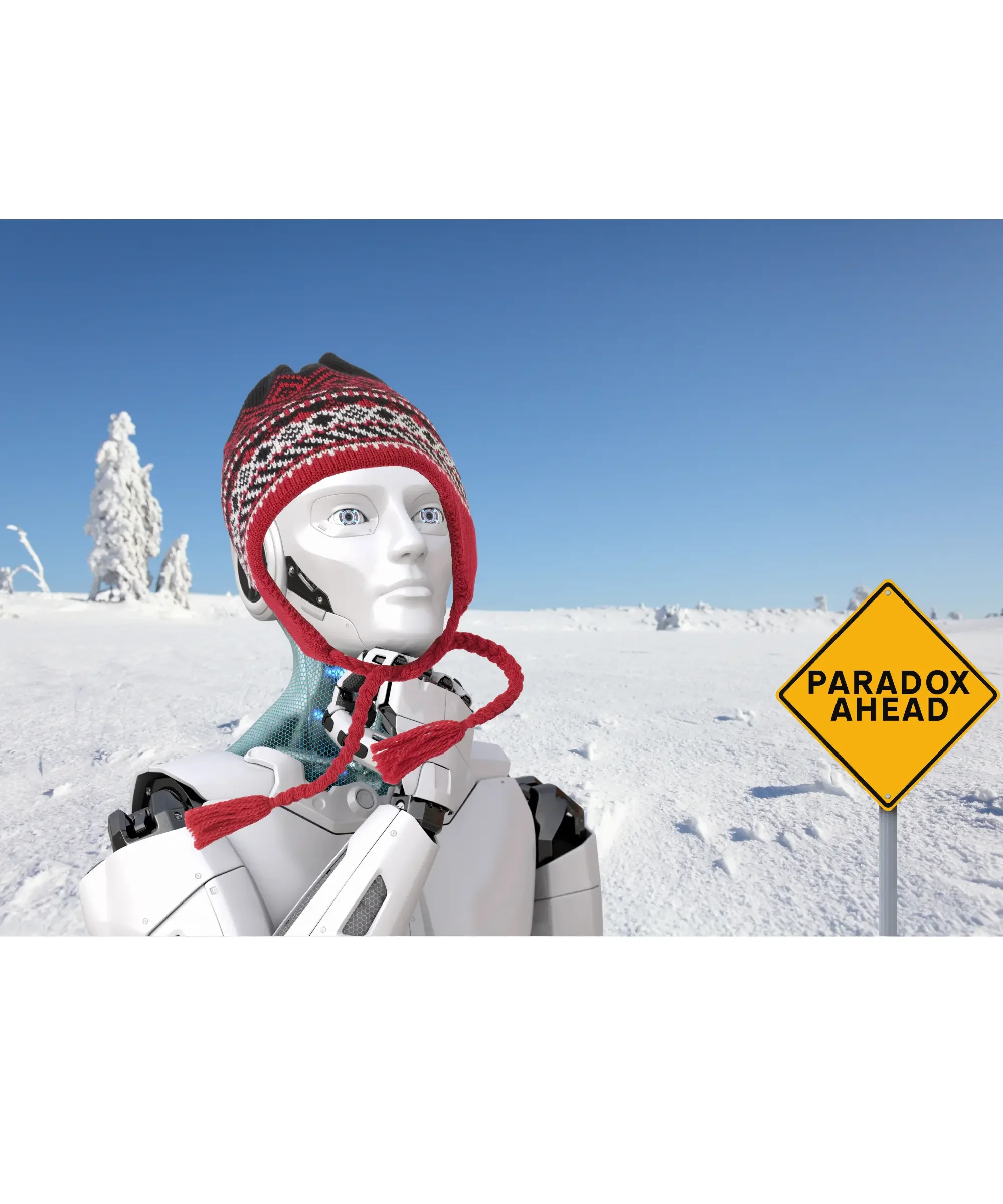
In a scenario of severe water scarcity, AI might prove indispensable: optimizing agriculture, managing climate systems, designing new desalination technologies, and predicting resource distribution.
AI will exist as long as we have energy, materials, and we maintain civilization. If humans ever leave Earth, AI will go with us. Its role inside civilization is already being reshaped by how Agentic AI is changing the way we work.
The future is not ending because artificial intelligence needs water. Right now, in North Dakota—the land in the heart of the Great Plains, where the cold is wild, energy abundant, and the wind has an attitude—AI is shedding its inefficient forms and learning better ways to exist.
Just like we always have.